
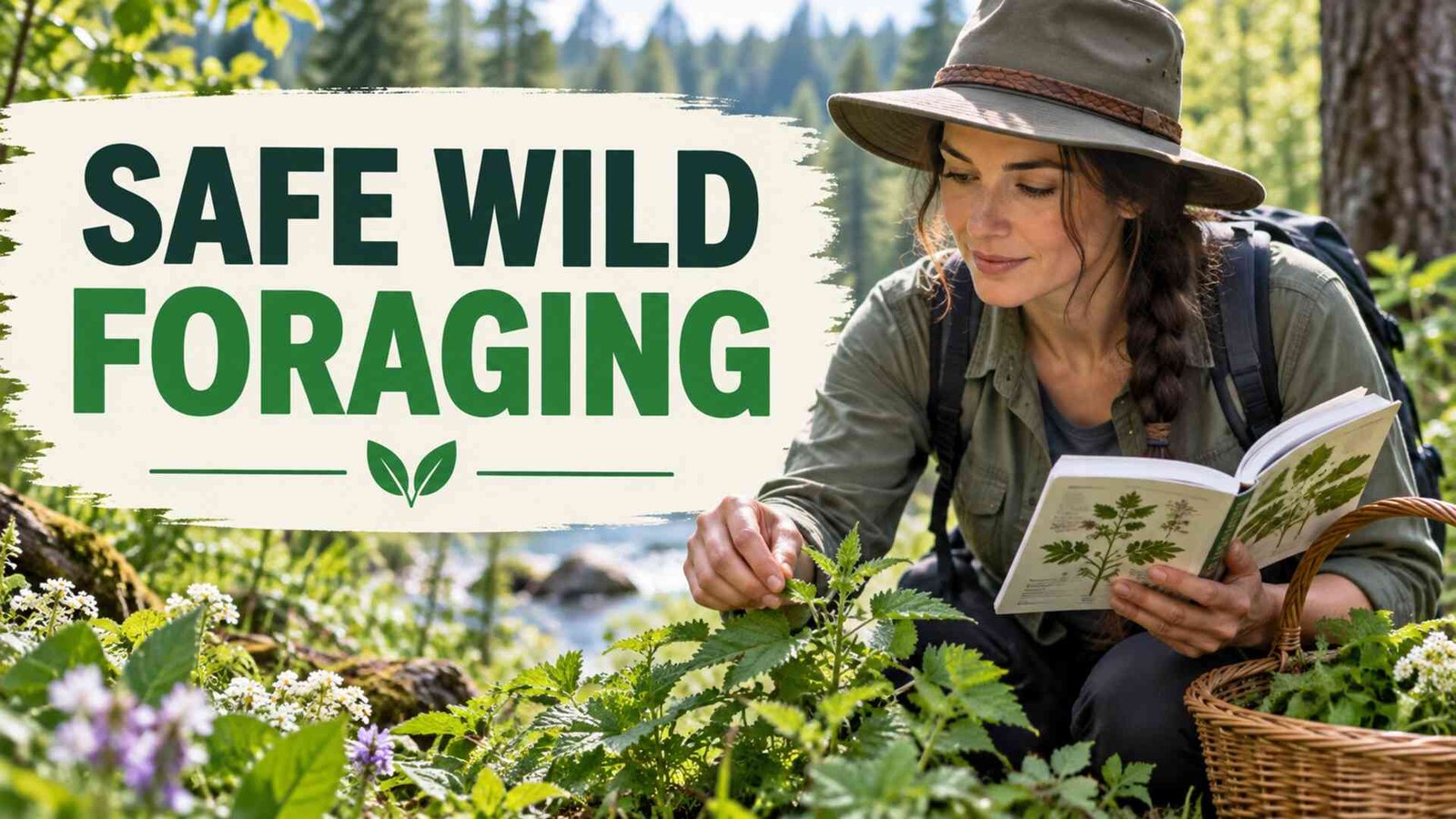
Safe wild foraging requires local expertise, legal permission and certain identification. No wild plant or mushroom should be described as foolproof: edible species can have dangerous lookalikes, and risks vary by region and individual health.
Core safe wild foraging rules
- Learn in person from a qualified local expert.
- Never eat something identified only through an app, photograph or general article.
- Know poisonous lookalikes before considering an edible species.
- Confirm land ownership, local regulations and harvesting restrictions.
- Avoid sites that may be contaminated or chemically treated.
Do not rely on distance rules
A fixed distance from a road, railway, industrial site or treated landscape cannot establish safety. Soil, water, pesticide and animal contamination may not be visible. Seek location-specific advice.
Protect habitats
Harvest limits differ by species, abundance and regulation; a universal fraction is not appropriate. Avoid rare or vulnerable plants, do not uproot perennial species unnecessarily, and leave enough for wildlife and regeneration.
Consider preparation and health risks
Correct identification does not guarantee a food is suitable for everyone. Some wild foods require specific preparation, interact with health conditions or medications, or cause allergy. Never taste a specimen to identify it.
For lower-risk sourcing, consider farmers market shopping or use the seasonal produce calendar.
When in doubt, leave it
Safe wild foraging begins with restraint. If identity, permission, site history or preparation is uncertain, do not harvest or consume the item.