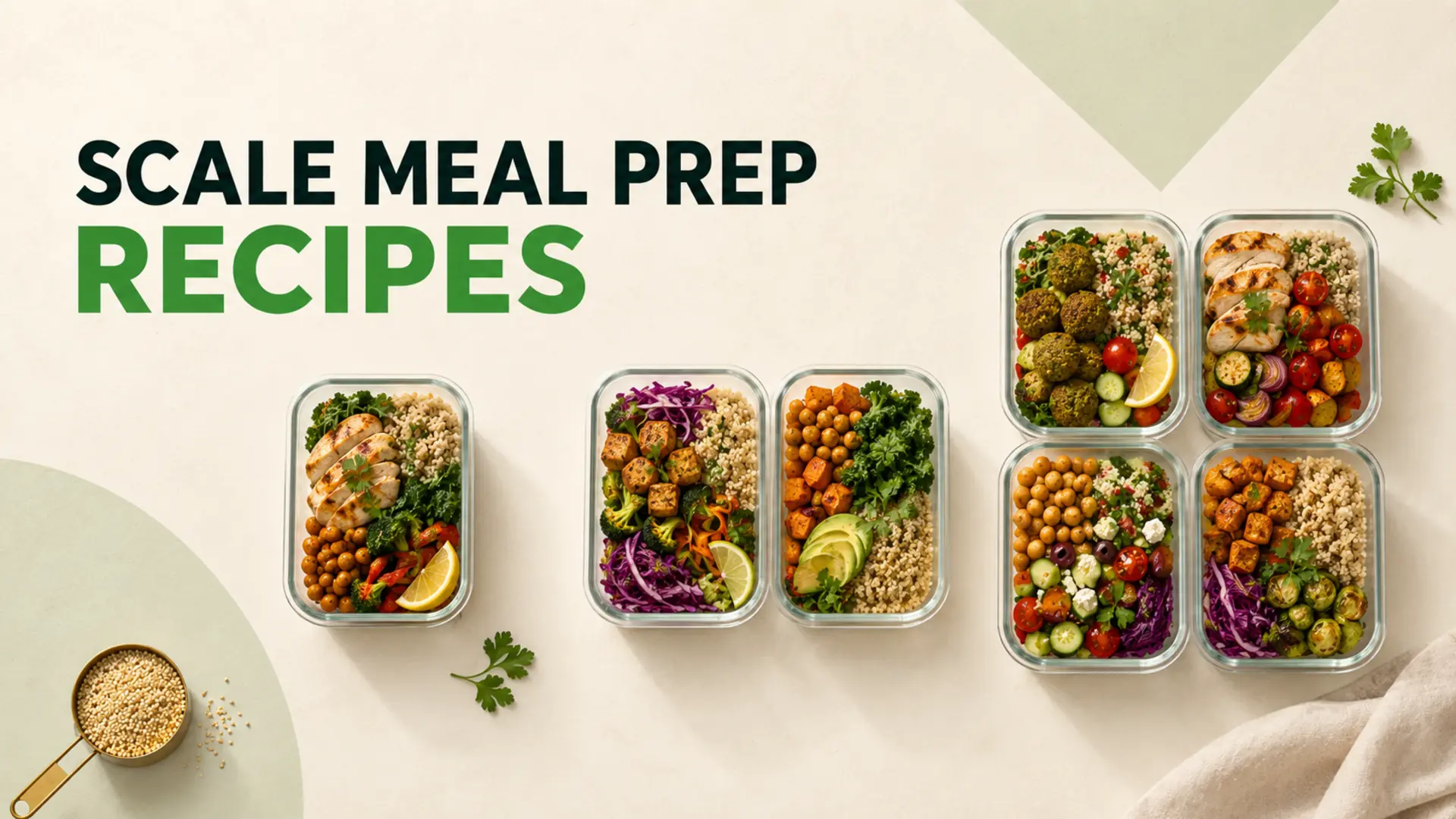
Learning how to scale meal prep recipes helps you cook the amount your household actually needs. The basic calculation is simple: divide the number of servings you want by the number of servings in the original recipe. That number is your scaling multiplier. Apply it to the ingredients, then check whether the cookware, cooking time and storage plan still make sense.
For example, a recipe written for four servings uses a multiplier of 0.25 for one person, 0.5 for two people and 1 for four people. The math is a starting point, not a promise that every ingredient or cooking time changes in exactly the same way.
Quick formula for scaling meal prep recipes
Target servings ÷ original servings = scaling multiplier
| Original recipe | Target servings | Multiplier | Example |
|---|---|---|---|
| 4 servings | 1 serving | 0.25 | 400 g becomes 100 g |
| 4 servings | 2 servings | 0.5 | 400 g becomes 200 g |
| 4 servings | 4 servings | 1 | 400 g stays 400 g |
| 2 servings | 4 servings | 2 | 200 g becomes 400 g |
Use the same unit throughout each calculation. If a recipe mixes cups, tablespoons, grams and package sizes, convert the awkward measurements before shopping. A kitchen scale can be useful when dividing ingredients that do not split neatly by volume.
Ingredients that usually scale directly
Many main ingredients can follow the multiplier closely. These include meat or plant-based proteins, dry grains, pasta, beans and most vegetables. If a four-serving recipe calls for two tins of beans, the two-serving version generally needs one tin. For one serving, it may be more practical to use part of a tin and plan the remainder into another meal.
- Proteins such as chicken, fish, tofu, beans or lentils
- Dry rice, quinoa, oats and pasta
- Fresh or frozen vegetables
- Stock added as a measured recipe ingredient
- Sauces that are mixed separately before cooking
Direct scaling still needs a reality check. Package sizes may not match the calculated quantity, and individual needs vary. Treat the result as a recipe quantity rather than a universal portion recommendation.
Ingredients that need extra judgement
Salt, chilli and strong seasonings
There is no reliable rule that every doubled recipe should receive a fixed reduced amount of seasoning. The result depends on the ingredient, cooking method and other salty or spicy components. Start conservatively when practical, especially with salt, chilli, concentrated stock and strongly flavoured condiments. Taste at a safe stage and adjust gradually.
Eggs and other indivisible ingredients
When a scaled recipe calls for half an egg, beat the egg and measure the required portion by weight or volume. Use the remainder promptly in another suitable dish. For recipes where egg structure is essential, such as some baked goods, choosing a recipe written for the desired yield may produce a more predictable result.
Baking ingredients
Baking depends on ratios, pan dimensions and heat movement. Weight measurements are usually easier to scale accurately than cups. Keep leavening and other structural ingredients in the original proportions unless the recipe author provides tested scaling advice. A much larger or smaller batch may also require a different pan.
Oil used for the pan
Oil used only to coat cookware depends more on the surface area than the serving count. Use enough for the chosen pan and cooking method instead of multiplying it automatically. Oil included in a dressing, marinade or batter can usually follow the recipe multiplier more closely.
Adjust the pan, not just the ingredient list
A small recipe spread across a large pan may cook faster or dry out. A doubled recipe crowded into the original pan can steam instead of brown and may cook unevenly. Choose cookware that keeps the ingredient depth and spacing reasonably similar to the original recipe.
- One serving: use a small skillet, saucepan or compact baking dish.
- Two servings: the original cookware may work if the food is not spread too thin.
- Four servings: follow the stated pan size when using the original yield.
- Larger batches: divide food between pans or cook in batches when crowding would affect the result.
For roasted meals, the flexible formulas in this 5-ingredient sheet pan dinner guide show why spacing and ingredient size matter as much as quantity.
Do cooking times scale with servings?
Cooking time does not usually double just because the ingredient quantity doubles. Small portions may cook faster, while a deeper casserole or crowded pot may take longer. Use the recipe’s visual cues, texture tests and safe doneness guidance. Check early when reducing a recipe, and allow extra time when a larger batch increases food depth.
For meat, poultry, seafood and reheated food, use an appropriate food thermometer and follow the food-safety guidance that applies where you live. Do not rely only on colour or a multiplied cooking time.
How much meal prep should you make?
Start with the number of people, meals and days you are actually planning. One person preparing three lunches needs three portions, not an automatic full week of every recipe. A couple may prefer two recipes with two portions each, while a household of four might cook one dinner recipe at its original yield.
- Count the meals the food must cover.
- Subtract meals already planned elsewhere.
- Consider whether everyone will eat the same dish.
- Check available refrigerator and freezer space.
- Choose variety before scaling one recipe into too many repeated meals.
If you are planning several meals together, the framework in How to Plan 21 Meals a Week can help separate breakfast, lunch and dinner needs before you calculate quantities.
Convert scaled recipes into a grocery list
After scaling each recipe, combine repeated ingredients. If two dishes require onions, add the quantities together before choosing a practical package size. Then check your pantry and freezer so food already available is deducted from the list.
- Write the target servings beside every recipe.
- Calculate and record each multiplier.
- Scale ingredients in consistent units.
- Combine duplicate ingredients across recipes.
- Subtract suitable food already at home.
- Round package purchases sensibly and plan any remainder.
Use the adaptable meal ideas and individual shopping lists in these high-protein meal prep plans as another example of organizing options before building one master list.
Store scaled meal prep safely
Make sure you have enough suitable containers before cooking a larger batch. Label prepared food clearly and follow local guidance for cooling, refrigeration, freezing and reheating. A larger recipe is only useful when it can be stored safely and eaten within an appropriate period. The freezer meal prep checklist includes practical packaging and labelling reminders.
Final scaling check
- Did you calculate target servings ÷ original servings?
- Did you check awkward ingredients such as eggs and strong seasonings?
- Does the cookware suit the new food volume?
- Will you judge doneness safely instead of multiplying the time?
- Have you combined quantities and checked pantry stock?
- Can the finished food be stored safely?
Once you use the same process a few times, it becomes much easier to scale meal prep recipes for one, two or four people. Keep the original yield, target yield and multiplier visible while cooking, and adjust future batches based on what your household actually eats.
For broader meal-balance guidance, consult the official recommendations for your country or region. The existing Canada’s Food Guide is one authoritative example.