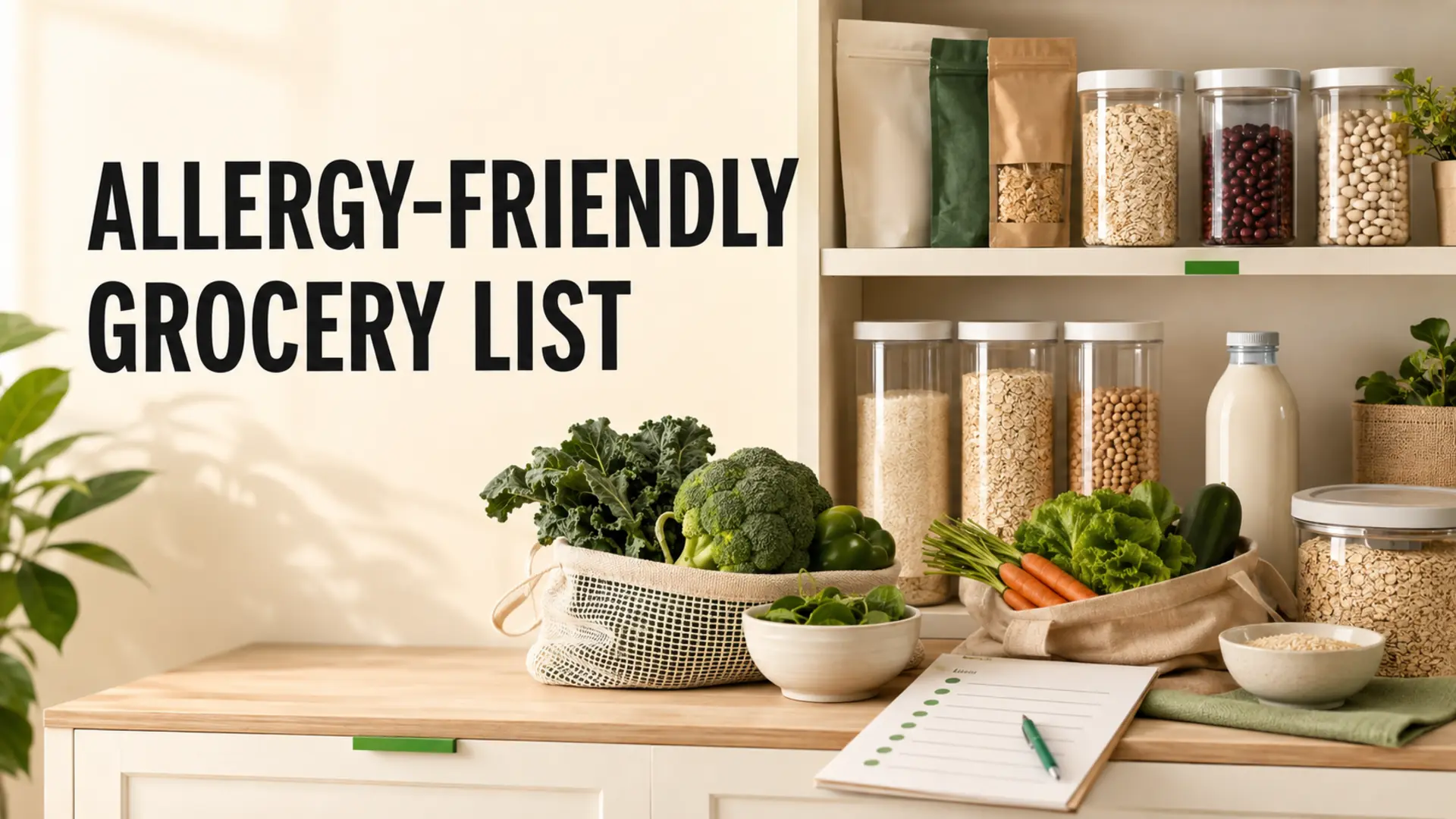
An allergy-friendly grocery list should identify the exact foods to avoid, preferred alternatives and any cross-contact limits provided by the person’s clinician. Read the complete label every time, even for familiar products, because ingredients and manufacturing details can change. When a label or store practice is unclear, choose another product or contact the manufacturer rather than guessing.
Food-allergy shopping is highly individual. A product suitable for one person may not suit another, and allergen-labelling rules differ by country. This guide provides a practical planning framework, not personal medical advice. Follow the diagnosed person’s allergy action plan and healthcare guidance.
Build an Allergy-Friendly Grocery List From Known Requirements
Start with the specific diagnosed allergens, not a generic “free-from” list. Record ingredient names, alternate names discussed with the clinician, acceptable substitutions and the household’s approach to precautionary statements. Keep this information available to every shopper.
- Avoid: the person’s confirmed allergens and relevant derivatives.
- Check every time: packaged foods, sauces, seasonings, supplements and prepared foods.
- Preferred alternatives: products already reviewed and tolerated, while still rereading the current label.
- Questions: items that need manufacturer, retailer or clinician clarification.
Before adding products, run a short pantry audit so the list reflects what is already safe and available.
Understand Cross-Contact
Allergen cross-contact happens when an allergen is unintentionally transferred to a food that would not otherwise contain it. This can occur through shared equipment, utensils, work surfaces, storage or handling. It is different from microbial cross-contamination, although both require careful food handling.
Cooking does not reliably make an allergen safe. The practical response is prevention: avoid uncertain exposure, follow the individual plan, and use cleaning and separation practices appropriate to the household. Food Allergy Research & Education provides a useful explanation of how allergen cross-contact occurs.
Read the Entire Food Label Every Time
Check the ingredient list, any required allergen declaration and any precautionary statement. Do not rely only on front-of-package wording such as “plant-based,” “natural” or “free from.” Marketing terms and regulated allergen declarations are not interchangeable.
- Confirm that the package and label belong to the exact product and flavour.
- Read the complete ingredient list from start to finish.
- Review the required allergen statement, where applicable.
- Look for precautionary wording about possible cross-contact.
- Check whether the product, package size or recipe has changed.
- If anything is ambiguous, do not assume it is suitable.
The FDA’s food-allergy guidance explains current United States requirements and notes that advisory statements such as “may contain” are voluntary. Other countries use different priority-allergen lists and wording, so check the authority where the food is sold.
Handle Precautionary Allergen Statements Carefully
Statements such as “may contain” or “made in a facility that also processes” communicate possible cross-contact, but wording and regulation vary. The absence of a precautionary statement is not, by itself, a guarantee that a product meets a particular person’s needs.
Do not create a universal rule that every person must treat every statement the same way. Instead, follow the risk approach agreed with the diagnosed person’s allergy specialist. Contact the manufacturer when the label does not answer a necessary question, understanding that a company may not be able to guarantee suitability.
Assess Higher-Uncertainty Store Areas
Some retail areas involve more shared handling than sealed packaged goods. Risk depends on the store, the food and the person’s allergy plan, so ask specific questions rather than relying on blanket assumptions.
Bulk bins and shared scoops
Open bins may use shared scoops or be exposed to spills. If that conflicts with the shopper’s cross-contact limits, choose an appropriately labelled sealed package instead.
Deli, bakery and prepared-food counters
Ask about ingredients, shared slicers, utensils, fryers, preparation surfaces and storage. If staff cannot provide enough information, select a different option. “Freshly prepared” does not mean allergy-friendly.
Damaged or leaking packages
Avoid torn, open or leaking packages. Separate any spill from the rest of the cart and notify store staff. Routine washing of every sealed grocery package is not a substitute for label reading and cross-contact controls.
Organize the List for Safer Shopping
Group the list by store section and mark items that require a detailed label check. Keep allergen notes factual and visible. A shared list can help, but each shopper still needs to understand the person’s requirements and what to do when a product is unavailable.
- List exact product attributes only when they are necessary.
- Add one or two reviewed alternatives for frequently unavailable items.
- Mark deli, bakery or bulk items that require questions.
- Do not approve substitutions automatically.
- Keep emergency contact information separate from ordinary shopping notes.
Households with multiple shoppers can adapt the responsibility ideas in this guide to coordinating grocery trips between roommates, while keeping allergy decisions with an informed adult.
Plan Safe Substitutions Before the Store
Choose alternatives by function: a suitable cooking oil, thickener, milk alternative, bread, snack or protein source. Compare labels independently; two products in the same category can have different ingredients or cross-contact statements. Nutritional needs matter too, especially when several food groups are excluded, so seek advice from an appropriately qualified clinician or dietitian when needed.
For a structured approach to supermarket decisions, the label-checking steps in this shopping-list and label-reading guide can be adapted without adopting its specific dietary program.
Unload and Store Groceries Deliberately
Put groceries away on clean surfaces. In a mixed household, use storage zones or closed containers when the individual plan calls for separation. Prevent spills, keep allergen-containing powders controlled, and make sure everyone understands which foods and utensils are shared.
- Clean hands and work surfaces before handling safe foods.
- Store open packages securely and keep labels with the products.
- Use clearly understood household identifiers rather than ambiguous colours alone.
- Clean utensils and equipment effectively between uses.
- Review pantry items whenever packaging or recipes change.
Prepare for Problems Without Making Assumptions
Anyone shopping or preparing food for a person with a diagnosed allergy should know that person’s emergency plan. Keep prescribed medication accessible as directed, recognize the plan’s warning signs, and contact emergency services when the plan says to do so. Do not use an online article to diagnose an allergy, test a suspected food or replace medical care.
If another health condition also affects shopping, keep the needs distinct rather than treating one diet as a solution for both. This supermarket meal-planning guide for diabetes illustrates how separate requirements can be organized without creating universal food rules.
Use a Repeatable Allergy-Friendly Shopping Routine
- Review the diagnosed person’s current avoidance and emergency plans.
- Audit safe foods already at home.
- Write the allergy-friendly grocery list with reviewed alternatives.
- Read every current label before buying.
- Ask specific questions in shared-preparation areas.
- Decline uncertain substitutions.
- Unload, store and prepare foods using the household’s separation practices.
An effective allergy-friendly grocery list does not promise zero risk. It reduces avoidable uncertainty through accurate information, consistent label reading, thoughtful substitutions and cross-contact prevention tailored to the individual. Keep the process simple enough that every responsible shopper can follow it every time.