Bulk buying groceries without waste starts with a simple question: will your household use the entire quantity before quality declines? A larger package is useful only when its unit price, storage needs and realistic consumption rate all make sense.
This approach works for warehouse clubs, supermarket multipacks, farmers’ markets and bulk-bin sections. It avoids rigid “always buy” and “never buy” lists because the right choice depends on household size, dietary preferences, equipment, climate and how often you cook.
Audit your storage before bulk buying groceries
Check the pantry, refrigerator and freezer before leaving home. Measure open shelf space, confirm that containers seal properly and leave enough freezer room for cold air to circulate. If the purchase has no clear storage location, reduce the quantity or skip it.
Review what you already own as well. This fridge-first meal-planning workflow helps prevent a bulk purchase from duplicating food that needs attention.
Estimate how quickly you use the item
Look at recent habits rather than an ideal future routine. Estimate how much your household uses in a typical week, then compare that with the package size. A large bag of rice may be manageable for one household and excessive for another.
Consider upcoming travel, schedule changes, dietary restrictions and whether everyone actually likes the food. Buying more does not create demand; it simply transfers inventory from the store to your home.
Compare the real unit price
Compare similar products using the same unit—such as price per kilogram, pound, litre or item. Then account for membership fees, transport, packaging and the portion likely to be eaten. A lower shelf label is not a saving if part of the product goes unused.
Also check the regular supermarket size. Promotions can make a smaller package competitive, and a smaller package may be a better value when it protects variety or prevents spoilage. This guide to meal prep mistakes at checkout covers unit-price and package-size comparisons in more detail.
Good bulk candidates are household-specific
Products that often work well are foods with a steady consumption pattern and storage conditions you can maintain:
- Dry grains, oats, pasta and legumes
- Canned foods that fit regular meals
- Frozen vegetables or fruit with enough freezer space
- Nuts and seeds when quantities suit your storage plan
- Frequently used spices, oils or condiments in practical sizes
- Paper or household goods that will not crowd food storage
Even shelf-stable foods are not unlimited. Follow package directions, keep them dry and protected from pests, and use older stock first. Organizing spices, oils and condiments by open date and usage rate can reveal which items are genuinely suitable for larger sizes.
Perishable bulk purchases need a meal plan
Fresh produce, bread, dairy products and chilled proteins can still be sensible bulk purchases when there is a concrete plan. Ask:
- Which meals will use the item?
- How much will be eaten fresh?
- Can part of it be frozen or cooked safely?
- Does the household enjoy it often enough?
- Can the package be shared before opening?
A large package of greens is not automatically wasteful, and fresh berries do not have a universal four-day life. Condition at purchase, variety, temperature, moisture and handling all influence quality.
Use bulk bins for the amount you need
“Buying in bulk” can also mean choosing a custom quantity from a bulk bin. This is useful for spices, grains, beans, nuts or ingredients needed for one recipe. Follow store procedures, use clean scoops and record product codes accurately.
The EPA advises that bulk-bin shopping can reduce waste and packaging when shoppers purchase only the amount they need and store it in airtight, labelled containers. Its current home food-waste guidance also recommends planning meals and checking existing food before shopping.
Plan the trip before entering the store
Make a list with four useful notes beside each candidate:
- Normal quantity used
- Unit-price limit
- Storage location
- Meals or uses planned
Keep optional purchases separate from essentials. This prevents an attractive display or large package from replacing ingredients needed for the actual week. A reusable shopping template can hold these notes without rebuilding the list every trip.
Handle chilled and frozen foods safely
Collect refrigerated and frozen foods toward the end of the trip when the store layout allows, keep raw animal products separated from ready-to-eat foods, and return them to temperature control promptly.
Contrary to the original draft, meat and poultry do not have to be removed from their original packaging before freezing. USDA guidance says original packaging is safe for freezing, although overwrapping with freezer-suitable material can help maintain quality during longer storage. See the official USDA freezing and food-safety guidance.
Portion and label according to how you cook
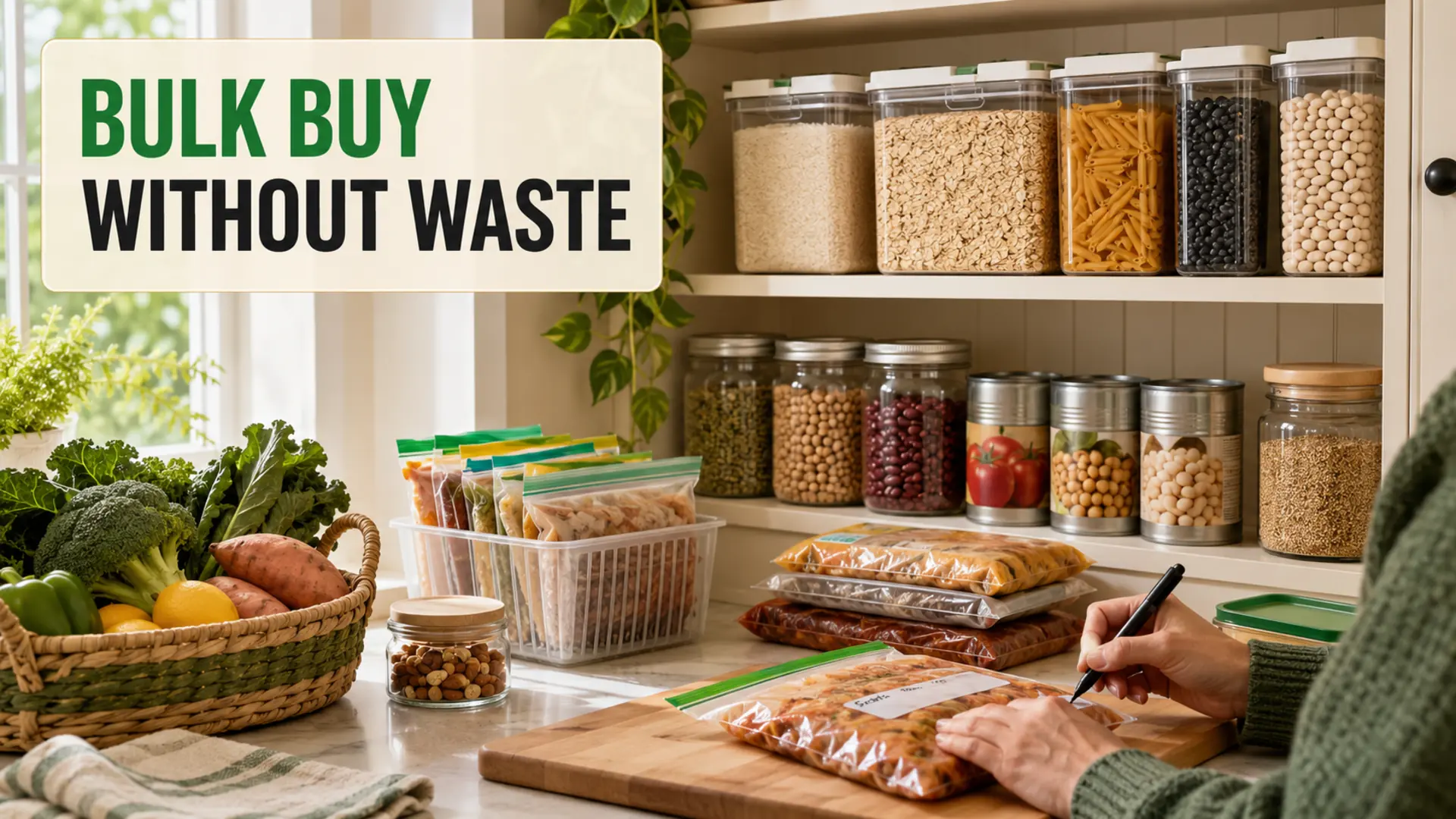
If a large pack is more than one meal, divide it into useful portions with clean tools and freezer-safe packaging. Label the food and date, remove excess air when practical and freeze in a shape that fits your storage space.
Portions do not need to be exactly one pound or two fillets. Use the amount your household normally cooks. Check the FoodSafety.gov cold-storage chart for item-specific refrigerator and freezer guidance; freezer time recommendations relate primarily to quality when food remains continuously frozen at the proper temperature.
Rotate inventory instead of forgetting it
Place newly purchased items behind older ones when practical. Keep a short freezer and pantry inventory, and review it before the next large shop. If an item repeatedly remains unused, buy a smaller package next time even if its unit price is higher.
Set one flexible “use what we have” meal each week. Soups, grain bowls, pasta, curries and tray bakes can absorb small amounts of compatible ingredients without relying on unsafe combinations.
A practical bulk-buying decision checklist
- Do we already have it?
- Do we use it consistently?
- Is the unit price genuinely better?
- Can we store it as directed?
- Will the quantity fit planned meals?
- Can it be divided without compromising safety?
- Would a smaller size preserve variety and reduce risk?
Buy larger quantities only when the system works
Bulk buying groceries without waste is an inventory decision, not a rule that bigger is always better. Match quantities to real consumption, compare like-for-like prices, plan storage before checkout and label anything you divide. The best bulk purchase is one your household uses comfortably—not the largest package available.