
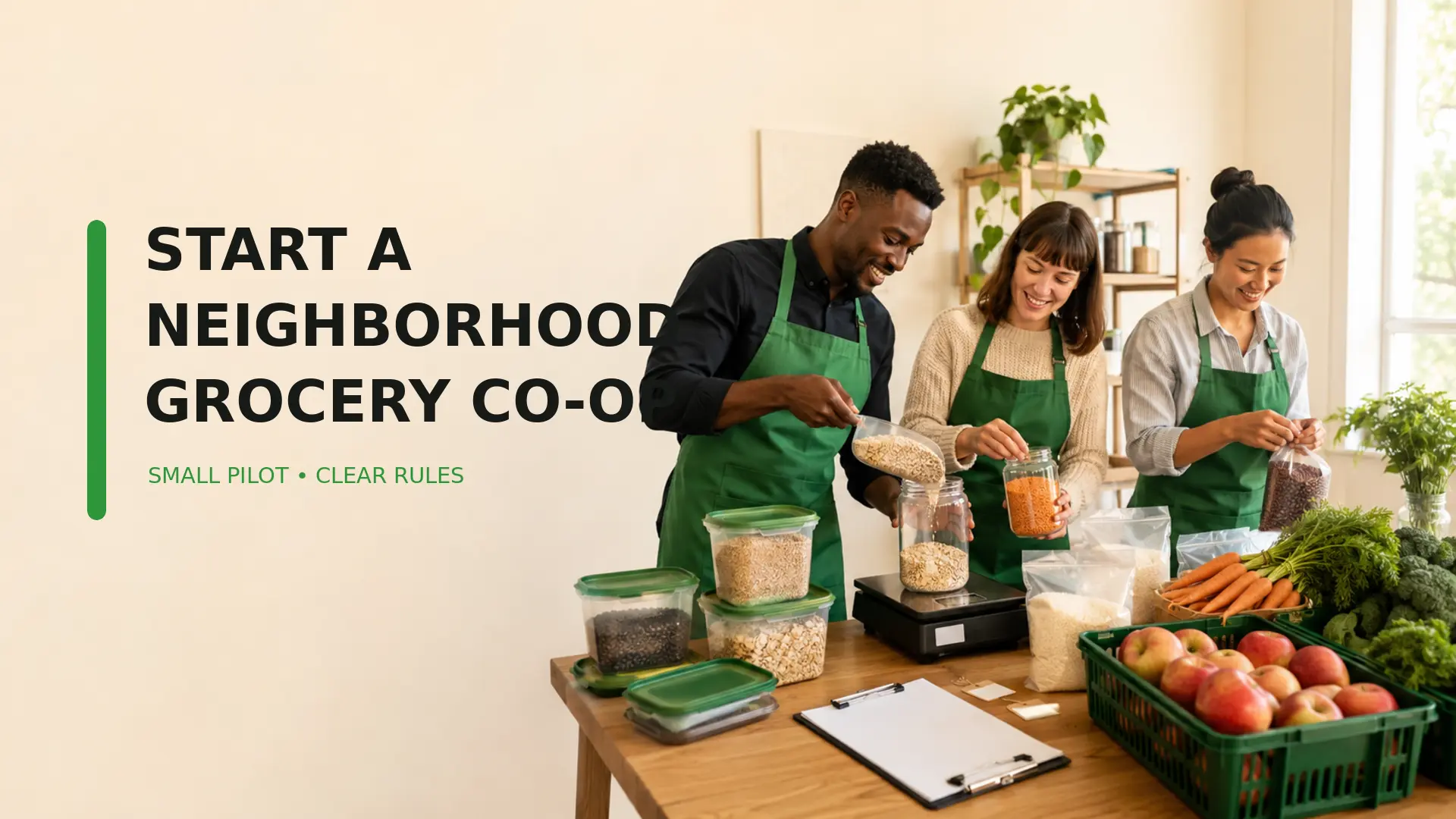
To organize a neighborhood grocery co-op, begin with a small trial order, written rules and products that are easy to divide safely. Confirm prices and fees before collecting money, assign clear roles, preserve supplier labels and check local rules. Bulk buying can reduce unit costs, but savings are never guaranteed once delivery, storage, waste and volunteer time are included.
What a neighborhood grocery co-op can do
A neighborhood grocery co-op or buying club combines orders from several households to reach a supplier’s minimum quantity or delivery threshold. It can be informal or legally organized, depending on its size, money flow and local law. The group may split sealed multi-packs, order produce cases or divide shelf-stable staples using appropriate equipment.
Before calling the arrangement a cooperative, check whether that term has a specific legal meaning where you live. Registration, taxes, insurance, consumer protection, food handling and weights-and-measures rules vary by jurisdiction. Local authorities or a qualified adviser can clarify requirements.
Start with a small, low-risk pilot
Invite a few households that communicate reliably, but do not require similar diets or family structures. Choose one order cycle and a narrow list of familiar products. Sealed multi-packs and shelf-stable dry goods are usually simpler for a first test than meat, dairy, frozen food or foods requiring temperature control.
- Set an order deadline and pickup window.
- Name one coordinator and one checker.
- Choose a spending limit and approved substitutions.
- Document how refunds, shortages and damaged goods will be handled.
- Decide what happens if someone misses pickup.
Survey household demand before contacting suppliers
Ask participants what they already buy, how much they can store and which allergens or dietary restrictions matter. A pantry audit helps each household avoid ordering products it already has. Collect nonbinding estimates first; confirm commitments only after the group sees final product details and costs.
Compare suppliers and the full delivered cost
Ask suppliers about minimum orders, case sizes, lead times, delivery zones, payment terms, substitutions, returns, traceability and allergen information. Do not assume farm-direct or wholesale prices are lower than retail promotions.
Calculate:
- product price
- delivery, membership or handling fees
- payment-processing charges
- food-safe packaging and labels
- shared equipment or venue costs
- expected waste or unclaimed portions
Then divide by the usable quantity each household receives. The bulk-buying cost method provides a useful framework even when the supplier is not a warehouse club.
Create simple written operating rules
Keep the first agreement short and clear. Record who may order, how prices are approved, when payment is due, who owns shared equipment and how the group makes decisions. Include a privacy rule: collect only the contact and payment information needed for the order, limit access and do not reuse it for unrelated purposes.
Use a shared list with one row per product and household. Our guide to shared digital shopping lists explains how visible updates can reduce duplicate ordering. Keep the supplier’s original invoice as the source of truth.
Collect payments transparently
Avoid asking one volunteer to finance a large order. Collect confirmed amounts before purchase, issue a simple receipt and keep co-op money separate from personal spending where practical. Use a payment method available in your country and explain any fees. Never publish participants’ balances or banking details in a broadly shared document.
Divide dry goods safely and accurately
If local rules permit repacking, use a clean, pest-free space; food-safe containers; clean utensils; and a suitable scale. Wash hands, prevent cross-contact and keep pets away. Preserve the product name, supplier, ingredient and allergen information, lot or batch identifier, and best-before or use-by details for every household. Never reuse containers that are unsuitable for food.
Do not improvise with products that require refrigeration or freezing. Maintain the required temperature throughout transport, sorting and pickup, or leave those products out of the pilot. Raw meat introduces additional handling, sanitation and liability concerns and should not be divided casually.
Handle produce and perishables carefully
For produce cases, inspect the delivery promptly and record damage. Agree in advance whether items are divided by count, weight or an equal mixed share. Participants should know the pickup time and storage needs. Donate or redistribute surplus only through methods accepted by local organizations and food-safety rules.
Plan an orderly pickup window
Stage completed household orders separately, mark them clearly and use a second person to verify quantities. Provide the receipt, storage instructions and supplier traceability details. Keep a contact method available for shortages or recalls. Avoid leaving food unattended in a garage, lobby or outdoors unless the location and temperature are appropriate.
Review the pilot before expanding
After pickup, compare the final unit cost with a realistic retail alternative. Ask whether the products were used, whether volunteers had enough time and whether any food or packaging was wasted. The EPA’s food-waste prevention guidance can help households plan quantities and storage.
- Repeat products that delivered real value.
- Reduce case sizes or participants when coordination was difficult.
- Rotate roles to avoid volunteer burnout.
- Stop products that created waste, safety concerns or disputes.
- Seek formal legal, tax and insurance guidance before significant growth.
Build a grocery co-op that can last
A neighborhood grocery co-op works when the process is more valuable than the complexity it creates. Start with a modest order, make every cost visible, protect participant information and treat food safety as essential. Expand only after the group has evidence that the arrangement saves money, reduces waste and shares work fairly.
Frequently Asked Questions
What is a neighborhood grocery buying co-op?
It is a group of households that combines orders to access bulk quantities or supplier pricing, then divides the food and costs. It may be informal or organized more formally depending on scale and local rules.
How many households should a grocery co-op start with?
Start small enough to coordinate easily—often a few reliable households—and run one limited pilot. Expand only after payment, ordering, division, pickup, and dispute procedures work consistently.
What foods are easiest for a first bulk order?
Sealed shelf-stable goods such as rice, oats, pasta, canned food, or factory-packed items are easier than perishables. Avoid repacking complex or allergen-sensitive products until the group has safe procedures.
How should co-op members divide costs?
Calculate product cost, tax, delivery, payment fees, packaging, and approved shared expenses before collecting money. Use written quantities and receipts so every participant can see how their total was calculated.
Should the organizer collect payment before ordering?
Usually, yes. Prepayment reduces the risk that one person finances the group or is left with unwanted food. Set a clear order deadline, refund policy, and plan for unavailable items.
How do we compare bulk pricing accurately?
Compare the full delivered unit cost with local retail prices for the same usable quantity. Include shipping, membership fees, repacking supplies, travel, spoilage, and the value of leftovers no household wants.
How can a grocery co-op handle food allergies safely?
Collect allergy information voluntarily, keep labels and ingredient lists, avoid cross-contact during division, and use separate tools and areas where needed. Do not promise an allergen-free process without the controls to support it.
Can neighbors repackage bulk food at home?
Local food, labeling, tax, and business rules may apply, especially when money changes hands or the group grows. Check local public-health and regulatory requirements before repacking or selling food.
How should perishable co-op orders be managed?
Use reliable cold storage, minimize time outside safe temperatures, schedule prompt pickup, and assign responsibility before delivery. A bargain is not worthwhile if the group cannot maintain the cold chain.
What written rules does a small grocery co-op need?
Document membership, ordering deadlines, payment, substitutions, refunds, unclaimed food, privacy, work assignments, allergens, food handling, and how the group will resolve errors or stop operating.