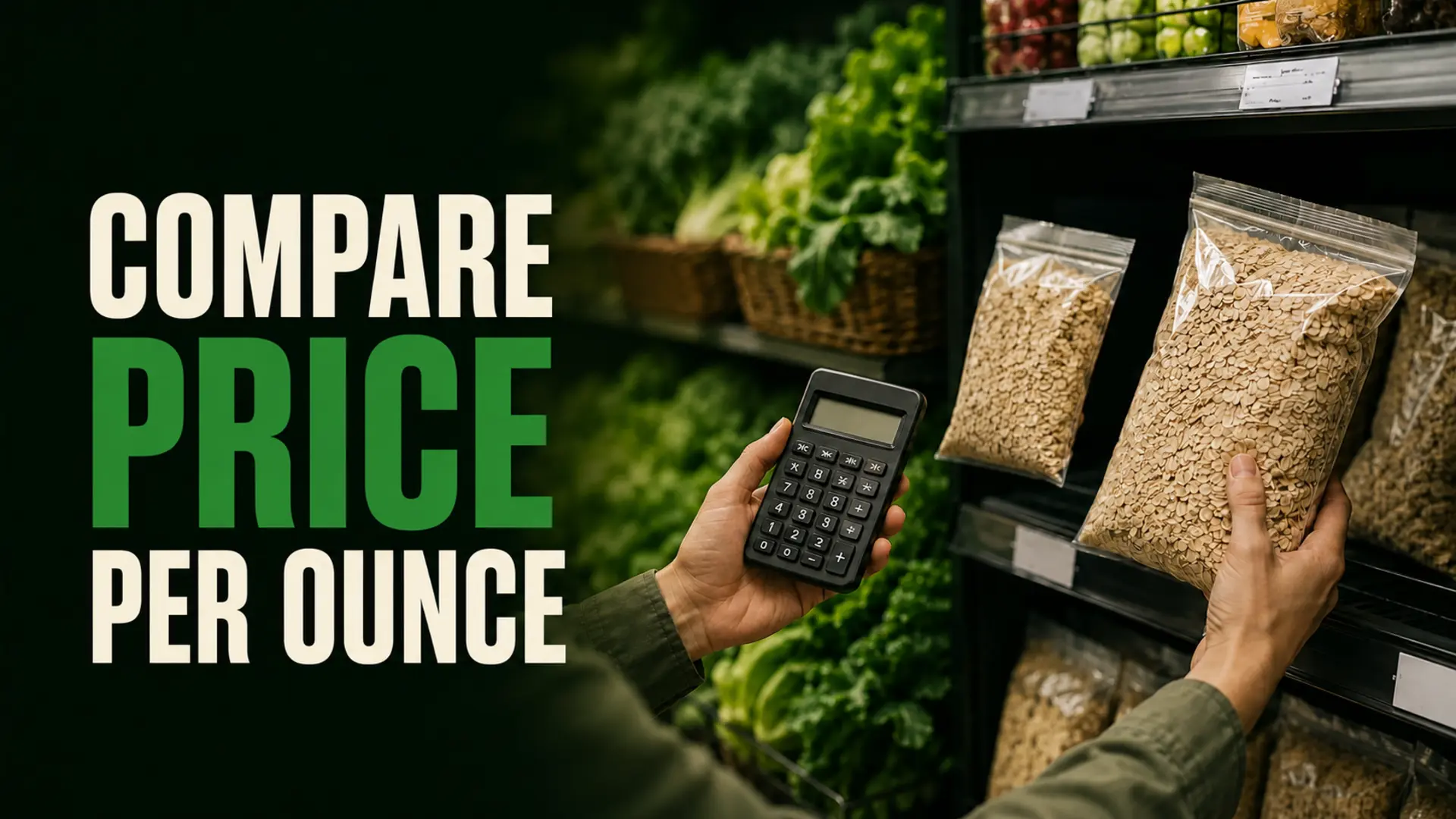
Learning how to compare price per ounce makes grocery packages easier to judge. Instead of relying on the shelf price, package size or “value” wording, compare products using the same unit. Many stores print a unit price on the shelf label; when they do not, a quick calculation gives you a fair comparison.
How to Compare Price Per Ounce
Divide the item price by the number of ounces in the package:
Item price ÷ package ounces = price per ounce
For example, a 16-ounce package priced at $4.80 costs $0.30 per ounce. A 12-ounce package priced at $4.20 costs $0.35 per ounce. The second package has the lower checkout price, but the first offers the lower price per ounce. Treat sample prices as illustrations; actual prices vary by store, region and date.
Read the Shelf Label First
Look near the product’s checkout price for smaller text showing a price per ounce, pound, gram, kilogram, litre, item or serving. The exact format varies among retailers and countries. Before comparing two labels, confirm that both use the same unit. A price per 100 grams cannot be compared directly with a price per kilogram until one is converted.
- Check the product name and size: shelf tags can be shifted or placed beneath a neighbouring item.
- Match the measurement: compare weight with weight and volume with volume.
- Include the current promotion: recalculate if a loyalty offer or multi-buy changes the price you will actually pay.
- Check the required quantity: “two for” pricing may not help if you need only one.
Calculate Unit Price When the Tag Is Missing
Use your phone calculator and the net quantity printed on the package. Enter the final price, divide by the package quantity and keep two or three decimal places when products are close. If one package uses pounds, remember that one pound equals 16 ounces. For metric packages, convert both products to grams or kilograms before dividing.
When comparing multipacks, calculate the total usable quantity across all packs. For products sold by count—such as eggs, tea bags or dishwasher tablets—price per item may be more meaningful than price per ounce.
Track Prices Without Slowing Down Your Shop
You do not need to calculate every item on every trip. Start with groceries you buy frequently or products offered in several package sizes. Record the usual unit price for a short list of staples, then update it when you encounter a meaningful change.
- Choose five to ten regularly purchased products.
- Write the brand, package size, store and date.
- Record the normal price and calculated unit price.
- Note a promotion only when you are eligible for it.
- Review the list occasionally and remove products you no longer buy.
A simple price record works especially well alongside a monthly pantry audit. You can check what is already available before deciding whether a larger pack is genuinely useful.
When the Lowest Price Per Ounce Is Not the Best Buy
Unit price measures cost, not suitability. A larger package can be poor value if part of it spoils, becomes stale or occupies storage you need. Choose the amount your household is likely to use safely. Quality, ingredients, dietary needs, convenience and personal preference also matter.
- Buy the smaller size when the larger one is likely to go unused.
- Consider whether the product can be frozen or stored correctly.
- Compare ingredient lists when products are not truly equivalent.
- Check whether a concentrated product requires a smaller amount per use.
- Do not buy extra merely to qualify for a promotion.
For larger purchases, use the same checks described in our guide to buying groceries in bulk without waste.
Common Unit-Price Mistakes
A sale sign can draw attention away from the actual quantity. Package redesigns may also make two containers look similar even when their net weights differ. Compare the printed quantity rather than judging by appearance. Avoid using fixed “good price” benchmarks copied from another place or year because currencies, markets and promotions change.
Another frequent mistake is comparing unlike products. Ready-to-eat rice and dry rice, for example, differ in water content and preparation. Unit price can still inform the decision, but it does not make the products interchangeable.
Use Unit Pricing in Your Grocery Plan
Add a short note beside flexible items on your list, such as “oats—compare unit price” or “tomatoes—fresh or canned.” Pair this habit with meal planning around supermarket sales so a low price supports meals you already intend to make.
Make Every Comparison Practical
To compare price per ounce effectively, use matching units, calculate from the price you will actually pay and consider how much your household can use. The lowest unit price is a helpful signal—not an instruction to buy more. A quick comparison plus a realistic grocery list usually leads to a better decision.